

Nobody tells you that the hardest part of being a woman veteran isn’t the hard parts.
It’s the in-between. The moment after the hard thing, when the dust settles, when the immediate crisis passes, when everyone around you exhales and looks at you expecting you to be fine because you always are; and you realize you have no idea what to do next. Not because you’re lost. Because the version of forward that worked before doesn’t fit anymore, and you haven’t found the new one yet.
So you do what we do. You keep moving. You produce. You perform. You justify your presence with output because that’s what got you here, and stopping feels like falling, and falling feels like failing, and failing is not an option you’ve ever allowed yourself to sit with for very long.
And nobody around you notices, because from the outside you look exactly like yourself.
Here’s the thing about the reflex to push through everything: it works, right up until it doesn’t. And when it stops working, it doesn’t announce itself. It just gets quieter, and heavier, and harder to explain to anyone who hasn’t lived inside the same formation.
Women veterans carry a particular kind of weight that doesn’t translate well. We’ve been in situations where the stakes were real, where the cost of being wrong was measurable, where the pressure to hold it together wasn’t just personal. It was professional, it was relational, it was moral. We learned to move through hard things without flinching because flinching had consequences.
That reflex doesn’t turn off when the context changes. It travels with us. Into jobs, into relationships, into seasons of life that look nothing like what we trained for. And the gap between what we’re actually carrying and what anyone around us understands we’re carrying, well, that gap is its own kind of exhaustion.
We keep moving because we don’t know what else to do. And somewhere underneath all that forward motion, something is quietly asking: is growing supposed to feel like this?
I want to tell you about a whiteboard.
My second son was born with a condition where his soft palate didn’t form, and his jaw developed inside his throat, blocking his airway. He had his first craniofacial surgery before he was twenty-four hours old. My husband rode with him in the ambulance to a different hospital. I couldn’t go until the epidural wore off, so I spent that first night alone in my hospital room, in a building where my baby wasn’t, waiting.
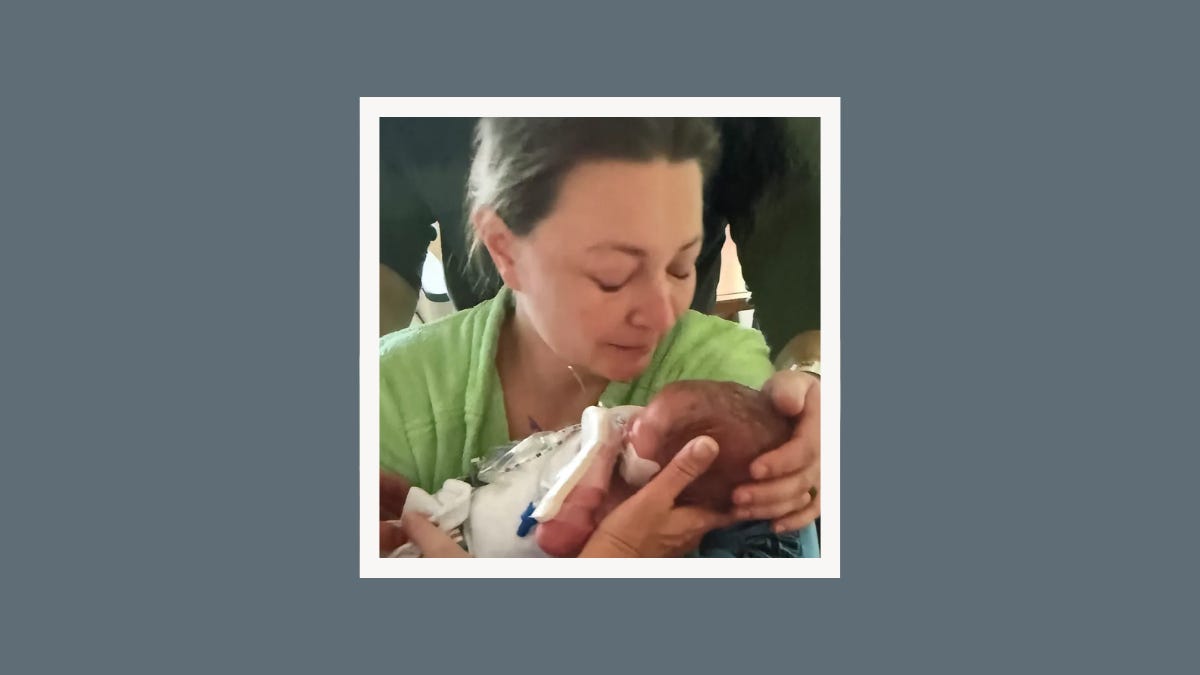
What I didn’t mention yet is that it was the very beginning of COVID. The hospitals were not calm places. And somewhere in the chaos of the delivery, the stress my body had been holding triggered an orbital pseudotumor behind my eye — a mass of inflamed tissue pressing against my optic nerve, stealing the peripheral vision on one side. So here I was, navigating a newborn in crisis, in a pandemic that was starting to crack open around us, and my own body was making the moment worse.
When I finally got to the other hospital, it was loud and fast and nothing like the pictures on the hospital brochures. My husband navigated us to where Oliver was and we stood together next to his incubator. I couldn’t touch him. He was being fed tiny amounts of formula through a syringe pushed into a feeding tube, and the world around him was moving at a pace that felt completely at odds with how still he was.
And then something on the wall caught my eye. Because of my restricted vision, I didn’t see it until it was directly in front of me.
His name — Oliver — written on a whiteboard. And underneath it, one word.
Goal.
I’m a fitness enthusiast. I have a genuine love for goals written on whiteboards. So I leaned in expecting numbers. A weight milestone. A feeding target. Something I could track.
What the nurse had written was one word.
Grow.
In the middle of all of it, the pandemic, the chaos, my own body sending up signals I didn’t have time to deal with, a hospital running at a pace nobody had trained for, Oliver’s only job was to lay there and grow. Not to perform. Not to demonstrate progress. Not to justify the resources being poured into that room. Just grow. Everything else was the terrain. His job was singular.
I’ve thought about that whiteboard a lot since then. Because I think we forget that growing is the goal. Not the output that proves we’re growing. Not the performance of recovery or resilience or having-it-together. Just growing. Coming out the other side of hard terrain more ourselves than when we went in.
It can be genuinely counterintuitive for a woman veteran to give herself permission to just exist inside a hard season rather than produce her way through it. We are conditioned to justify our presence with output.
But in the middle of one of the most chaotic moments I have ever lived through, the entire space was organized around Oliver doing one thing.
Growing is not a passive thing. It is not weakness dressed up in softer language. It is the whole point.
Oliver turns six this year and starts t-ball in the fall. He is doing just fine.
On Wednesday I’m publishing something I’ve been building toward for a long time: a framework for naming the terrain women veterans move through when the path disappears, the manual doesn’t exist, and every option has a cost attached. It’s called The Wilderness, and it’s the first chapter of something bigger.
If any part of today landed for you, if you felt something shift when you read the word grow, Wednesday was written for you.