
Preserving a Legacy: The Story of Muskegon's Vietnam Veterans of America Chapter 31

Kate Hoffmeyer is one of ours. Retired Lieutenant Colonel, U.S. Air Force. Combat veteran. Former B-1B Weapon Systems Officer. She serves as our peer support specialist at Mission Ambition, LLC, and this story is hers to tell.
In March 2026, I had the opportunity to sit down with Dale Tuttle, a longtime member and former president of the Vietnam Veterans of America (VVA) Chapter 31 in Muskegon. As a peer support specialist working with women veterans in Muskegon today, I was struck by how much of the work we do mirrors the foundation that Dale and others built decades ago—creating spaces for connection, understanding, and healing.
What began as a conversation quickly revealed itself to be something more urgent—a desire to preserve a history that risks being forgotten.
Founded in 1982, VVA Chapter 31 was once a vibrant and active presence in Muskegon County. Though now inactive as of April 2025, the chapter leaves behind a legacy of service, camaraderie, and advocacy for veterans that spanned decades. On paper, the organization still lists about 70 life members, but like many Vietnam-era organizations, time has taken its toll.
Dale Tuttle served as president of Chapter 31 for its final two full terms and remained deeply involved in many of its most meaningful efforts. His reflections offer a window into both the impact of the organization and the importance of ensuring its story is not lost.
A Mission Rooted in Service
The Vietnam Veterans of America was unique in its membership criteria: any veteran who served during the Vietnam era was eligible to join, regardless of whether they were deployed to Vietnam. This inclusivity created a broad and supportive network of veterans navigating similar experiences.
Chapter 31 was known for its wide-ranging programs, many of which addressed the complex realities veterans faced after returning home. One of the most impactful was their incarcerated veterans outreach program. Members would go into local prisons to connect with fellow veterans, offering understanding, support, and a sense of shared experience. According to Tuttle, this program was both “interesting and in-depth,” and it ran for many years.
Equally significant was the Vietnam Veterans RAP (Rap Group), a peer-based support model that met twice weekly from the late 1980s through 1998. Members received training through the VA hospital to become group facilitators, creating a structured yet deeply personal space for veterans to process their experiences. Tuttle himself served as a facilitator from 1994 to 1998. The program later evolved into a couples RAP group, continuing until around 2020—an early example of what is now widely recognized as peer support.
Recognizing Women Veterans in Chapter 31
While much of Chapter 31’s history reflects the experiences of its predominantly male membership, women were also part of the chapter’s legacy. Gina Fossler, a U.S. Army veteran and lifetime member of VVA Chapter 31, represents those contributions. Her involvement underscores a broader truth: women veterans have long been present in these communities, helping shape the kind of connection and support that continues today.
Community Presence and Fundraising
Beyond support services, Chapter 31 was deeply embedded in the Muskegon community. In the 1980s, the group actively fundraised to sustain its programming. One of their most visible efforts was at the annual Seaway Festival, where members organized and managed parking operations. By coordinating parking in high-demand areas, they raised significant funds while becoming a familiar presence at one of the city’s most popular events.
Another cornerstone event was the state council summer picnic, hosted locally at the Elks picnic grounds. Chapters from across Michigan would gather with their families, sharing food and fellowship in an annual tradition that strengthened connections across the state.
Building a Lasting Memorial
Among the accomplishments the chapter is most proud of is the creation of the “Final Approach” Vietnam Veterans Memorial site, conceived in the late 1990s, now located in Hidden Cove Park near Mona Lake. The site features a Vietnam-era helicopter, a UH-1H, and stands as a powerful tribute to those who served.
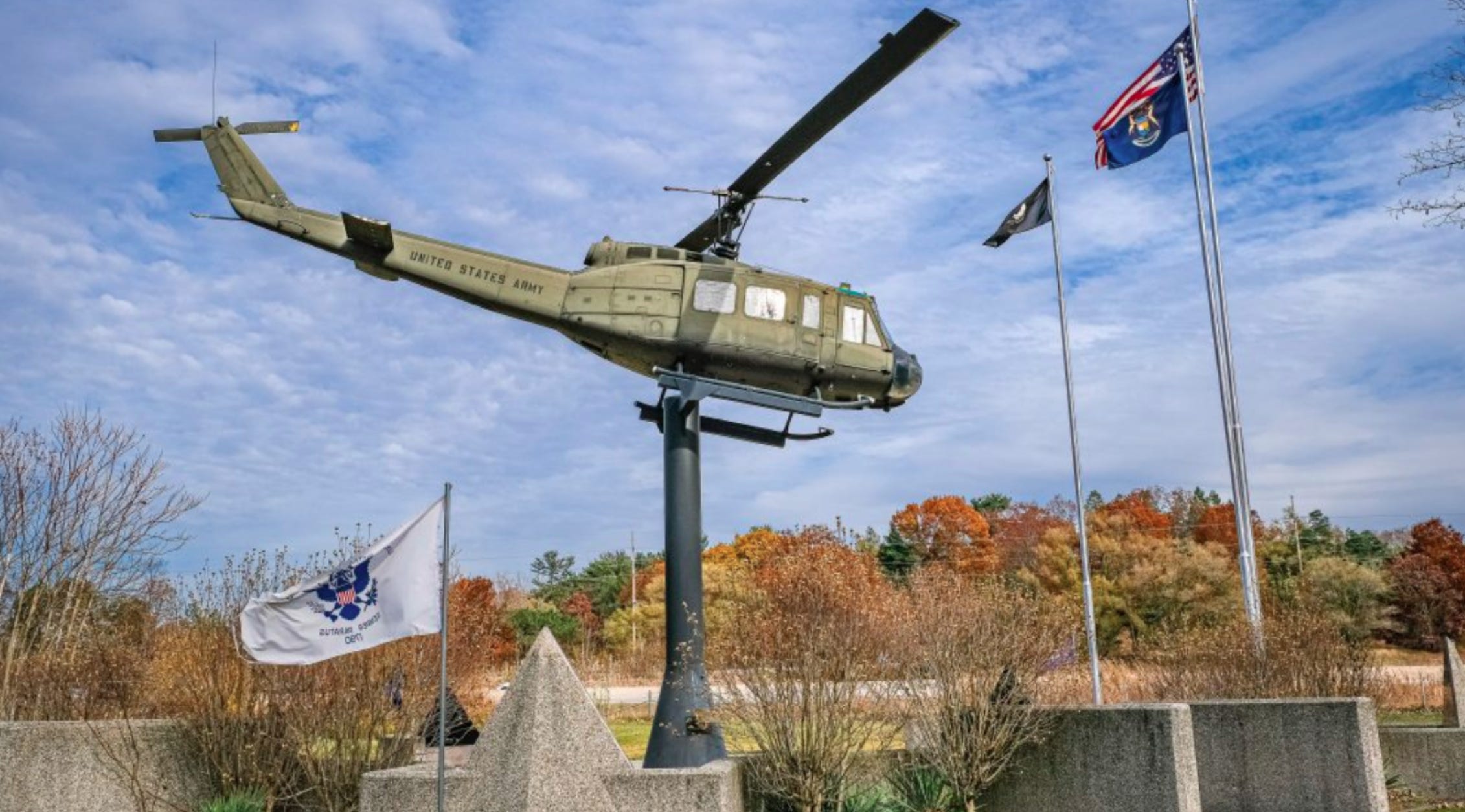
Chapter 31 was instrumental in planning, organizing, and building the memorial, with great help from community donors and providers. The helicopter itself remains property of the U.S. Army, while the site is now maintained by the City of Norton Shores. A pavilion on the grounds provides space for reflection and remembrance. Even today, a dedicated committee member continues to help oversee its care.
Challenges, Projects, and Contributions
Not every effort was without difficulty. Tuttle recalled the ambitious acquisition of a WWII PT boat, which involved complex logistics to bring it to Muskegon. It was thought to be the last of its kind, the AVR-661. Ultimately, the boat proved too costly to repair, creating additional challenges for the group to manage.
Despite setbacks, Chapter 31 consistently gave back to the broader community. At one point, the organization donated $5,000 to the Muskegon Maritime Museum, supporting the preservation of local and military history.
Tuttle has also worked to ensure that the chapter’s story endures. He donated a collection of archival materials—carefully preserved in an olive drab Army typewriter box—to the LST curator, with hopes that these documents will become part of future Vietnam-era exhibits.
Honoring the Fallen: A Continuing Commitment
One of the most enduring efforts led by Chapter 31 is the placement of flags on veterans’ graves at Oakwood Cemetery in Muskegon. For many years, Tuttle has coordinated volunteers to ensure that every veteran’s grave is marked ahead of Memorial Day.
The work begins on weekdays leading up to the holiday and continues through the Saturday prior, requiring significant coordination and dedication. Tuttle also personally maintains, manages, and stores the flags for Oakwood Cemetery.
Now, he is searching for someone to take over this responsibility. “Put your thinking caps on,” he urges—hoping the community will step forward to continue this meaningful tradition.
A Personal Story Still to Be Told
While Tuttle shared extensively about the chapter, he spoke more quietly about his own service. He was inducted into the U.S. Army on June 2, 1970, completing basic training at Fort Knox and advanced infantry training at Fort Polk before deploying to Vietnam later that year.
Arriving in-country on November 3, 1970, he was assigned to Company B, 2nd Battalion, 7th Cavalry, 1st Cavalry Division, operating in the III Corps region north of Bien Hoa. In March 1971, following unit reductions, he was transferred to Company B, 3rd Battalion, 21st Infantry, 196th Infantry Brigade, serving in the I Corps area near the Antenna Valley and the Que Son Mountains, southwest of Da Nang. Throughout nearly all of his field duty, Tuttle served as the radio chief for his infantry platoon. He witnessed the realities of war—moments of hardship, loss, and lasting impact but rarely divulges this, noting that many other troops experienced far worse.
He returned to the United States later that year and was separated from active duty at Fort Carson on December 13, 1971, with the rank of Specialist 4 (SP4).
Like many veterans, his transition back to civilian life was not easy. He expressed a sense that, after his Vietnam tour, the Army no longer had a place for him—a feeling not uncommon among those who served during that time.
An Era Coming to a Close
Today, the future of the Vietnam Veterans of America is uncertain. While the national organization continues, there are ongoing conversations about what happens as its membership ages. Some question whether the organization should sunset when the last Vietnam-era veteran passes, or whether its mission can and should continue through others.
For Tuttle, the urgency is clear: the history must be recorded now.
In reflecting on the legacy of Chapter 31, Tuttle shared a sentiment that speaks not only to their past, but to the enduring purpose of their work:
“Members of Chapter 31, Vietnam Veterans of America—present, and eventually all past—hope history will recall us: for the initiative and fire in the belly to form a new veteran organization; for service to community, culminating in the memorial park ‘Final Approach’; and for our belief and devotion to VVA’s founding motto: ‘Never again will one generation of veterans abandon another.’”
A Legacy Worth Preserving
The story of VVA Chapter 31 is one of service beyond the uniform—of veterans continuing to show up for one another and their community long after their military service ended.
As this era draws to a close, the responsibility to remember shifts to the rest of us.
And thanks to voices like Dale Tuttle’s, that story still has a chance to endure.
About the Author

Kate Hoffmeyer is a retired Lieutenant Colonel, U.S. Air Force, combat veteran, and former B-1B Weapon Systems Officer. She serves as peer support specialist with Mission Ambition, LLC and is part of the Be At Ease, Woman Veteran™ team. Learn more at womanveteranstrong.org.
This position is funded by HealthWest dba Muskegon County and the Michigan Department of Health and Human Services, through the Community Mental Health Association of Michigan, via a Federal Community Mental Health Block Grant and a Substance Abuse Prevention and Treatment Block Grant.
Looking forward to sharing this with Dale Tuttle—maybe it will also help find someone to carry on the flag detail.